Job Opportunity: Research Fellow in Urban Mobility
The Consumer Data Research Centre (CDRC) at Leeds delivers insights into human behaviour using consumer and commercial datasets, and we are looking for a Research Fellow in Urban Mobility who can help us deliver greater impact from our data assets and projects.
We’re seeking an ambitious Research Fellow in Urban Mobility fascinated by urban mobility data who can support work on advancing theory and methods relating to urban mobility and most crucially, work on emerging insights that ultimately have impacts on policy.
You will work closely with Professor Ed Manley, to develop new ideas and approaches for modelling urban mobility. You will gain experience in a rapidly developing, interdisciplinary field that will benefit a future career in academia or data science.
The successful candidate will have the opportunity to work with colleagues from Leeds Institute for Data Analytics, along with our external partners. We are currently working with Wejo and Spectus to make connected vehicle, mobility and location data more readily available for research purposes.
You will have an approach to research and level of technical expertise that allows you to draw out new insights and models of mobility behaviour from large datasets.
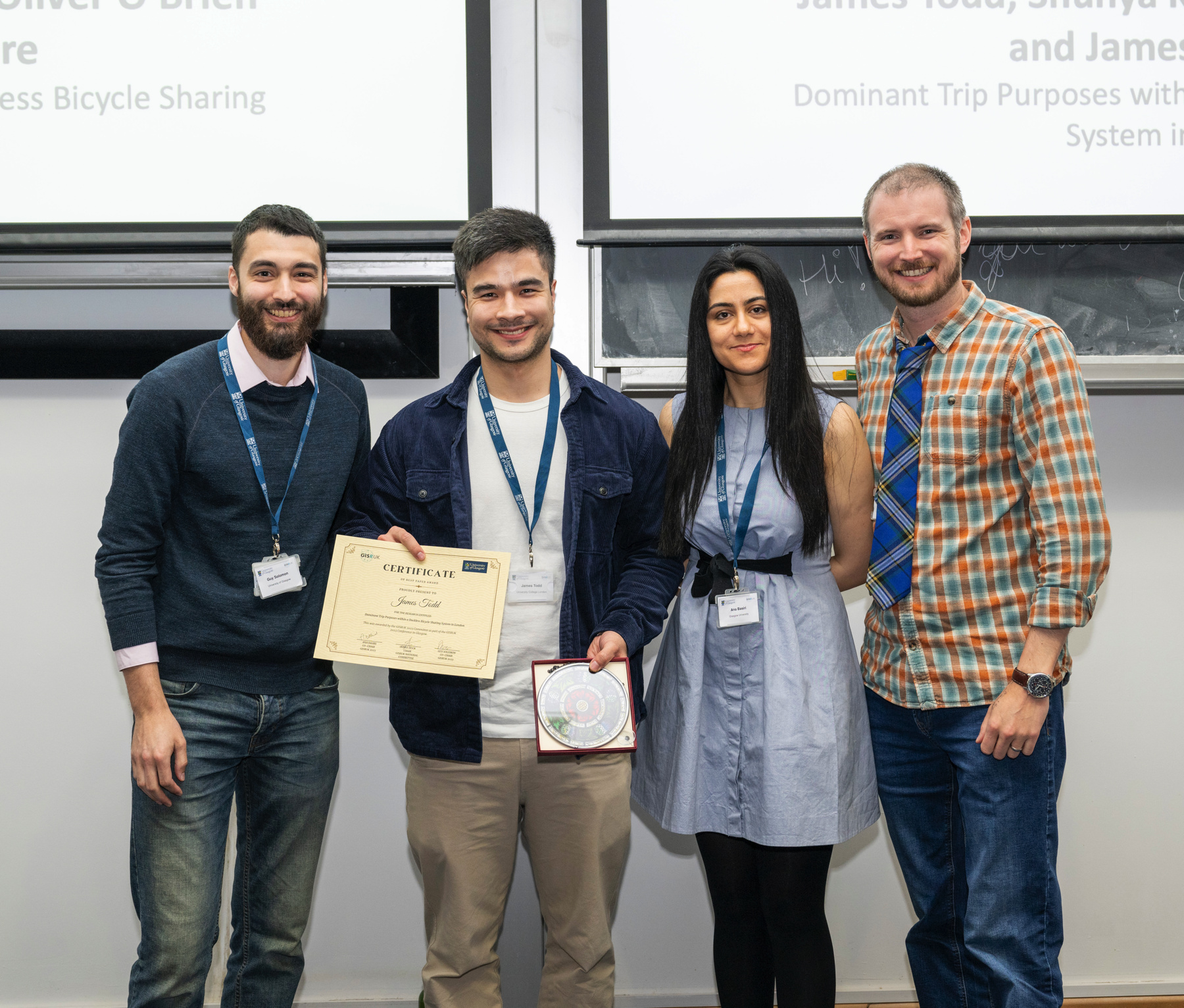
Lead author Dr James Todd, CDRC data scientist, winner of GISRUK 2023 Best Paper, with the conference organisers.
The 2023 edition of GISRUK (Geographical Information Science Research UK) conference took place in late April at the University of Glasgow with over 150 delegates, and saw a strong representation from CDRC-aligned Ph.D students and centre staff, with one of the centre’s data scientists winning the Best Paper prize.
The paper, “Dominant Trip Purposes within a Dockless Bicycle Sharing System“, was presented by lead author Dr James Todd, with co-authors Oliver O’Brien, Shunya Kimura and Professor James Cheshire, all of the Department of Geography at UCL. The paper was one of three shortlisted in advance by conference organisers and then voted on by participants towards the end of the conference.
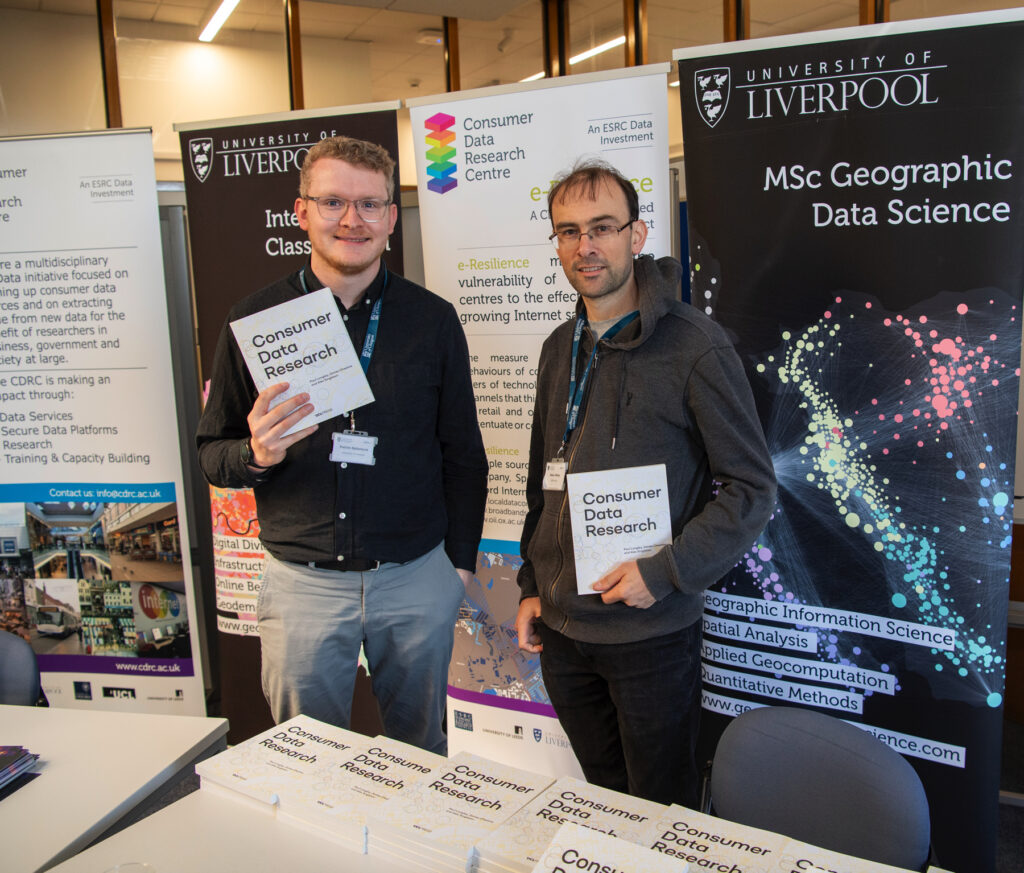
CDRC was also a conference sponsor and had a stand at the event’s poster session, showcasing some of the latest CDRC research and also the Consumer Data Research book produced by the centre and published by UCL Press. CDRC staff outlined the centre’s mission and modus operandi, and a number of copies of the book were given to interested attendees.
CDRC’s Dr Patrick Ballantyne (Postdoctoral Research Fellow) and Centre Technical Manager Oliver O’Brien, with copies of the centre’s Consumer Data Research book, at the GISRUK 2023 poster session.
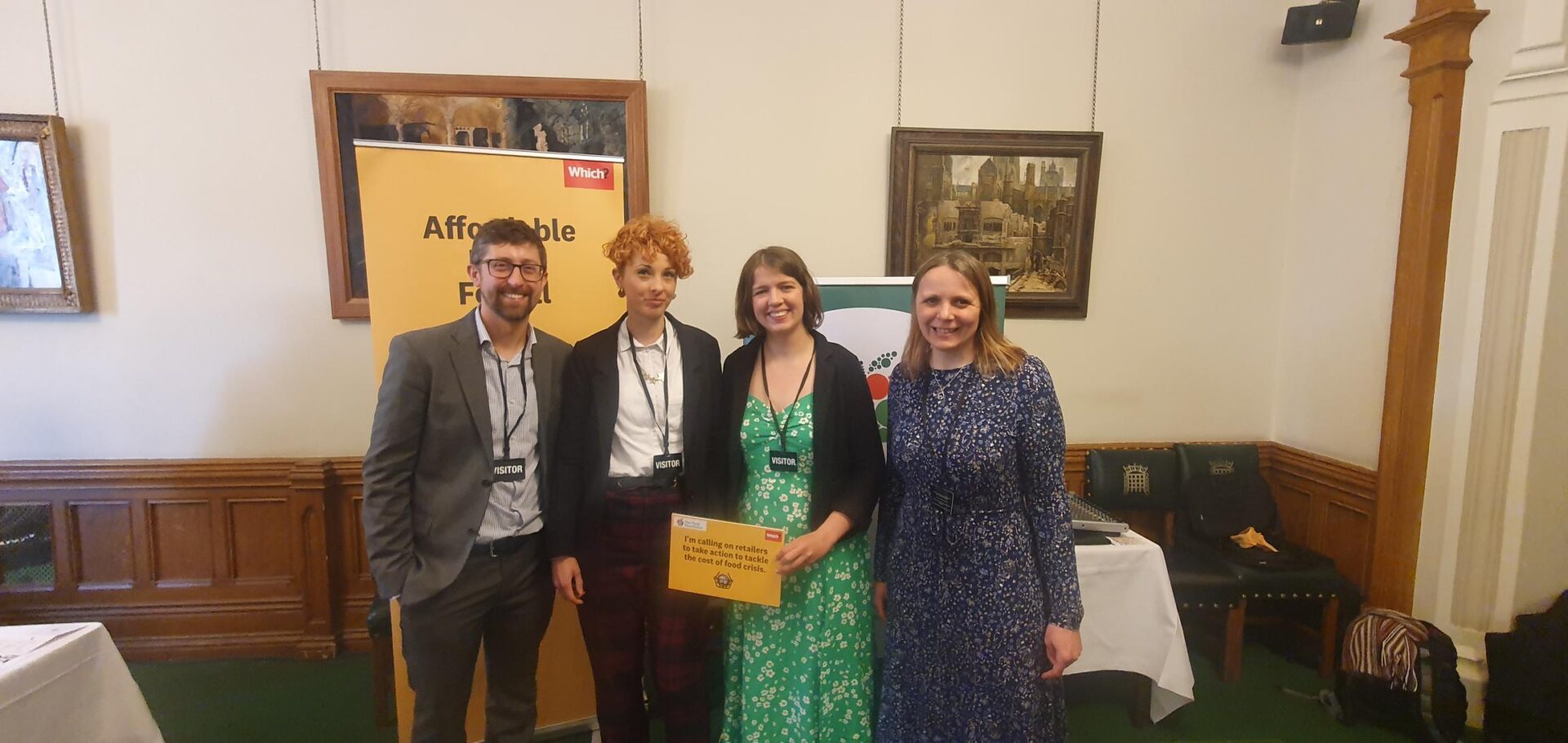
The CDRC Priority Places for Food team were invited to the House of Commons earlier this week in order to share their work on food insecurity.
The event, ‘Tackling the Cost of Food Crisis’, was set up to share new research, led by Which?, on the availability of budget range options in small and large supermarket stores, and to launch a new film by The Food Foundation highlighting the lived experiences of those living in the areas of highest food insecurity.
CDRC’s Priority Places for Food Index (developed last year in collaboration with Which?) emphasises that food (in)security is determined both by access to food and the obstacles blocking access to that food. As a result, this event brought together policymakers, MPs, charity organisations and those with lived experiences of food insecurity and diet-related ill health, with the joint objectives of working together to improve access to affordable food and to remove the social barriers currently limiting access to that food.
The Priority Places for Food Index demonstrates that access to supermarkets plays an important part in the UK’s food security. Good access to supermarkets includes both online access (including availability of online delivery as well as the likelihood of individuals in a particular location to shop online) as well as in-person access (including proximity, travel time, and travel options to supermarkets).
Which? calls on supermarkets to do more
Which? took this research further, by exploring what choices consumers have if they have limited access to larger supermarkets and need to shop in smaller stores. Their research involved sending a team of mystery shoppers into 123 different-sized branches of Asda, Morrisons, Sainsbury’s and Tesco across the UK to assess the availability of a range of essential budget groceries.
Each shopper was armed with a list of around 29 different basic budget groceries to find in each store, and the results show that those core budget items were almost all available in larger stores, and almost all unavailable in smaller stores.
The shopping list used by Which? was developed in collaboration with CDRC researchers, and the outcomes of Which?’s research emphasised that having access to supermarkets was not always a guarantee that consumers could access affordable food. In fact, the items available in different-sized stores are not configured to cater to the areas in which those stores are located, but in fact based on store size (with a larger range of budget items available in larger stores, not areas of greater need).
Which? have called on retailers to do more to tackle food insecurity by ensuring budget ranges are available in smaller stores, using the Priority Places for Food Index as an example of how to determine which areas in the UK need access to affordable food most urgently. You can sign their #AffordableFoodForAll campaign here.
The Food Foundation – Sharing lived experiences
The powerful and emotional film launched by The Food Foundation focused on the lived experience of Melissa, who lives in Solihull, and who describes how difficult it is to feed her children during the cost of living crisis.
The Food Foundation used the Priority Places for Food Index to determine an area of particularly high food insecurity – Birmingham – and in the video, uses the expertise of GP Dr Ewan Hamnett to highlight the long-lasting health implications of food insecurity for individuals and, more long-term, the additional stress health inequalities are likely to place on the health and social care systems in future.
Alongside the launch of this video, the Food Foundation have made demands on both retailers and Government to ensure everyone can survive the cost of living crisis and eat well.
In particular, The Food Foundation called for the expansion and strengthening of the healthy start voucher and free school meal schemes.
The Priority Places for Food Index includes the eligibility and uptake data for these schemes. You can read more about the work CDRC has done previously on free school meals here, and read also how Dr Michelle Morris’s work with retailers has evidenced the value in expanding the healthy start voucher scheme.
What happens next?
The event was a reminder to all attendees that the cost-of-living crisis and its impacts are not going away any time soon, and that in order to effect change we need to get a clear picture of the extent of the problem.
The combined effect of the Priority Places for Food Index, Which?’s secret shopper research, and the accounts of lived experiences provided via The Food Foundation provide the evidence necessary to prompt action, with many attendees at the event signing the declaration on affordable food put forward jointly by Which? and The Food Foundation.
Furthermore, guests at the event were able to spend time using the Priority Places for Food Index, exploring how they as individuals or organisations can use it to develop targeted interventions to improve food security.
Which? also used Priority Places data to provide constituency-level evidence packs for the MPs in attendance, placing the evidence of the levels of food insecurity and contributing factors to that insecurity into the hands of decisionmakers.
Journalist and Radio 4 presenter Sheila Dillon, who chaired the event, said that it was hard not to be moved by the video created by The Food Foundation, and on Twitter noted that coming together for the event – with representation from both the Conservative and Labour parties – gave her hope that ‘democracy might be working’.
Dr Emily Ennis, Research and Impact Manager, Consumer Data Research Centre (Leeds)
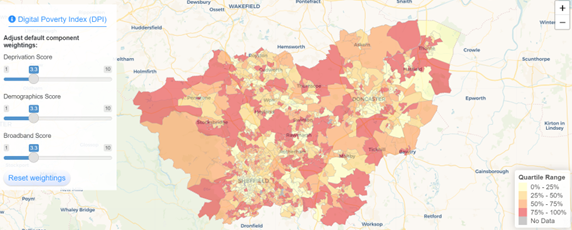
Researchers at the University of Sheffield used several CDRC datasets as part of their research into digital poverty in South Yorkshire. The South Yorkshire Mayoral Combined Authority (SYMCA) wanted a better understanding of how digital poverty and digital exclusion play a role in the region, and how to build digital capability in the region, particularly for social groups identified as at risk.
The research team mapped digital poverty in the South Yorkshire region. This allowed them to assess the areas at greater risk of digital poverty, by highlighting the intersections of different inequalities and barriers that different social groups in the region experience. This provided a place-based nuanced understanding of which populations and areas are more affected and thus potentially excluded from the labour market, education, and services due to being digitally excluded.
The findings are helping SYMCA create a positive impact in the region: they will inform the region’s COVID-19 recovery plan and the agenda for implementing their Inclusion Plan and is providing feasible and research- and evidence-informed pathways towards alleviating digital exclusion and digital poverty. Besides supporting the most disadvantaged citizens, by leveraging the findings of this project, SYMCA will be better able and prepared to create further digital development opportunities in the region, e.g., by supporting the development of literacies, entrepreneurship, and talent- thus supporting its economic recovery.
The project was funded through the Knowledge Exchange Support Fund (QR Policy and Covid Recovery) and supported by the South Yorkshire Office for Data Analytics Pilot.
We have been working with Wejo to make connected vehicle data available for academic research purposes.
We have today launched a new dataset, supplied by Wejo, which contains GPS trajectories for around 50,000 vehicles during the month of July, representing over 1.8 million vehicle journeys and over 400 million individual records. An observation is available every 3 seconds on average during each journey.
The data contains a journey identifier, timestamp, longitude and latitude coordinates, as well as additional data fields for vehicle speed and bearing. The data is of high quality, with GPS records for every three seconds on average. This enables the successful implementation of map-matching algorithms as well as the identification of vehicle stops as well as periods of acceleration and deceleration.
This is one of the first times such a detailed and in-depth dataset detailing connected vehicle trajectories has been made available for academic research purposes.
Thinking of applying to our 2023 Masters Dissertation Scheme (MDS)?
We asked the winners of the 2022 MDS prize about what attracted them to the MDS and how they got involved. In these short videos Aindrila and Alex tell you about the benefits of the MDS and how their experience, working with industry, is supporting their career development.
Disa Ramadhina, winner of the Best Dissertation 2021, went straight to a Data Analyst role, following her Masters. In this YouTube clip Disa describes how she was able to add value to the partnership between academia and industry and how the MDS experience helped progress her career at Entain.
Thinking of applying to our 2023 Masters Dissertation Scheme (MDS)?
Ten years ago, the Economic and Social Research Council funded a nationwide collaborative Masters Dissertation Scheme for the first time. Over the years, businesses, government and third sector organisations have collaborated with universities throughout the UK to allow Masters students to develop practical solutions to problems through applied research, often using their own sources of data that are not usually available for student projects. Sponsoring organisations solve problems, students get real world problem-solving experience, and many students have gone on to work for the organisations that sponsored their research projects. This year’s projects can be viewed here. As in previous years, there is likely to be very considerable interest in these projects, so interested students are advised to apply as soon as possible!
CDRC data used to understand population displacement from gentrified London council estates with surprising results
New research using our novel Linked Consumer Registers has found that the demolition and associated redevelopment of council estates in London has displaced former residents, potentially separating them from their existing employment, education and care networks. Yet around 85% of the displaced in remain London, and most stay within the same Borough. This suggests that the scale of displacement may be less than has previously been suggested, particularly in the popular press. However, there is also evidence of increasing numbers of moves out of London to the Southeast and East of England.
The full paper in published in Environment and Planning A, authored by Jon Reades, Loretta Lees, and Phil Hubbard.
AHAH is a multi-dimensional index for Great Britain measuring how “healthy” neighbourhoods are based on the locations of services that are ‘assets’ or ‘hazards’ for health in each area.
AHAH is calculated based on data from 15 indicators divided into four domains:
Health services – GPs, hospitals, pharmacies, dentists, leisure services
Air quality – air pollution levels for Nitrogen Dioxide, Sulphur Dioxide and Particulate Matter (PM10)
Natural environment – green spaces and blue spaces
The resource allows researchers and policy makers to understand which areas have poor environments for health and helps to move away from treating features of the environment in isolation to provide a comprehensive measure of neighbourhood quality.
AHAH is produced for Lower Super Output Areas for England and Wales, and Data Zones for Scotland. Component inputs for this index use data that is the most up-to-date as of March 2022.
All of the individual indicators to AHAH have also been made freely available in the data resource in a push for opening up small area health data. As such, it provides one of the most comprehensive free data resource available for such data. You can freely explore how your local area compares on our data at https://mapmaker.cdrc.ac.uk/#/access-healthy-assets-hazards. AHAH and all of the individual indicators are openly available at https://data.cdrc.ac.uk/dataset/access-healthy-assets-hazards-ahah.
Changes from previous versions
The latest version of AHAH includes several methodological and conceptual refinements following extensive public feedback on previous versions.
Most noticeable is the change in how we measure accessibility to green spaces. We received a lot of user feedback, especially from rural communities, who did not feel that measuring distance to nearest accessible park or green space was the best measure since it under-represented rural areas (i.e., farmland that is green but not necessarily accessible).
In response, we have updated the measure to use a satellite derived measure of the total green space (NDVI). We note here the measure is for the resident population and their surrounding contexts.
This has improved the accuracy for measuring access to overall green space. These changes have resulted in changes in the overall AHAH index value, mostly seeing rural areas with good access to green spaces having better overall scores. As a result, we would suggest caution in making comparisons over time between the overall AHAH index.
We have also further updated our statistical approaches to give more accurate accessibility estimates and utilize GPU support for faster processing.
Researchers from CDRC have provided vital data analysis as part of London Borough of Camden’s Future High Streets programme
The aim of the programme is to ‘re-imagine’ high streets for the 21st century and ensure they are the heart of community and economy.
Even before the COVID-19 pandemic, high streets across Britain were facing a multitude of challenges, including:
the ongoing shift away from traditional retail to online shopping
a decline in footfall
higher costs due to rising business rates and commercial rent
The pandemic compounded these issues. National lockdowns closed non-essential stores and changed behaviours in various ways, with fewer commuters visiting central London locations.
In response, Camden Council devised the Camden Future High Streets programme to support its high streets through the pandemic and into a robust recovery and ready to face the future.
Professor James Cheshire, Deputy Director of the Consumer Data Research Centre and his team, collaborating with Camden, performed an extensive search for high street related data and datasets in six main categories: high street boundaries, mobility, economic, retail, social and demographic, and sustainability. They used pre-existing data to show changes over time and differences between high streets in order to inform local policy.
“We’re sort of a data of broker,” explains James. “Part of that role is acquiring data, processing it, and giving it back in a way that people can make good use of. But I also think we can be an impartial advisor on what data is good and what data is less good. We don’t have any real sort of commercial imperative to be selling a particular data product so we can impart an honest view.”
James and his team produced a detailed report, Data for Future High Streets, containing their insights and six recommendations of how data can be better used to improve resilience and vibrancy of high streets.
Abigail Hill, played an important role in the project, with elements of her PhD research included the report and utilised by Camden.
“The knowledge exchange with the London Borough of Camden has enriched my research that focuses on measuring the resilience of British high streets,” she says. “The project provided invaluable insights into high street regeneration projects and decision making, enabling my research to make an impact on local policy.”
Councillor Danny Beales, Cabinet Member for Investing in Communities, Culture, and an Inclusive Economy (Camden Council), comments: “It’s been a productive collaboration. Working with UCL provided valuable insights into how London Borough of Camden can use data, including the data we already hold, more effectively to support the recovery of our high streets after COVID.”
You can read more about the Resilience of British High Streets to the COVID-19 Lockdown Restrictions here.